Competitive gaming is currently a nightmare for anybody stuck using gear that cannot process frames locally. Lag from remote servers turns a fast paced shooter into a loading loop that feels like moving through mud. GeForce RTX 5090 local ai gaming solves this specific headache by moving the work away from off-site server farms and onto the desktop.
Instead of waiting for a signal to travel across the country, the machine on the desk handles every calculation in milliseconds. This shift identifies a specific win for users who are tired of being one step behind the pack. Building a high-performance rig in 2026 requires a move away from the umbilical cord of remote server farms.
The situation is simple for anyone who values their ranking or their sanity. Most people are chasing a brand name while ignoring the physical bottlenecks that ruin an immersive session. Organizations are currently stuck in the corporate ai failure mess because they keep waiting for off-site connections to get faster.
Neural rendering outcomes identify a specific win for local processing while Blackwell technical documentation for the GeForce RTX 50 Series Graphic Cards and Laptops reveals the engineering needed for high-speed visual results.
Brute force memory for localized results
Thirty two gigabytes of GDDR7 memory is the primary mechanical victory for this unit. Most graphics adapters in the mid-range tier struggle because they run out of room to think during high-density moments. This massive pool of high-speed VRAM ensures that the machine holds entire models locally to prevent the stuttering that kills accuracy.
VRAM results are stable even when the visual load hits its highest point. Having this much memory means the unit doesn’t have to swap data out to slower system lanes. It is a specialized tool for people who want a permanent fix for the loading icons and blurry textures that plague smaller cards.
Most “pro” setups are currently failing because they don’t have the guts to run these tasks without calling for help from an outside server. This ASUS build provides the raw muscle needed to stay independent. It is an honest piece of engineering that respects your desire to stay ahead of the competition.
Thermal engineering for high density rigs
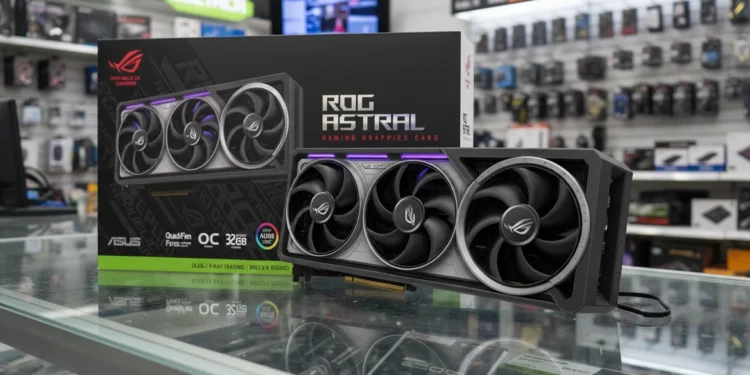
Managing the heat from such a powerful chip is a requirement for long-term durability. The quad fan layout on the shroud is an aggressive response to the thermal spikes of Blackwell silicon. These four fans create a high-pressure air tunnel that forces heat away from the core components with impressive speed.
Vapor chamber mechanics and server-grade thermal gel handle the hot spots on the board. This setup ensures that the hardware stays stable during marathon sessions in a warm room. While the noise floor rises when the fans hit full speed, the outcome is a card that refuses to throttle its own output.
Heat is the enemy of any high-end build, and this unit fights it with brute force. The industrial shroud textures and reinforced structure identify a build meant for years of heavy work. It feels like a solid piece of gear that won’t break the moment the workload increases.
PCIe 5 0 bandwidth and system synergy
PCIe 5.0 integration provides a high-speed lane that doubles the bandwidth of older motherboards. This technical choice ensures that the graphics adapter has a clear path to communicate with the rest of the rig. Having a wide lane is a necessity for anyone who wants to see the actual results of the 5090 engine.
Motherboards from last year are already becoming a bottleneck for this level of throughput. Savvy builders need to look at their entire system to ensure the hardware synergy is there. If the lanes are crowded, even the best GPU will act like a mid-range toy.
The power draw for this unit is equally massive. A 1000-watt power supply is a baseline requirement to ensure stable energy delivery during heavy usage. It is a steep investment, but the return is a machine that never stumbles when the action gets intense.
Winning the technical race for the new year
Competitive shooters and high-resolution RPGs demand a level of precision that off-site servers cannot deliver. This graphics adapter removes the uncertainty of the cloud and puts the control back into the hands of the player. It is a powerhouse for productivity that justifies the entry price by delivering a genuine advantage.
Winning requires gear that reacts as fast as the human brain. The ASUS ROG Astral RTX 5090 identifies a path to success for users who are fed up with the latency lie of remote processing. It is the only smart move for a high-end gaming setup that wants to stop being a passive onlooker.
Choosing a smarter path for your rig
Remote server lag and the nightmare of failed experiments disappear when the gear on the desk is built for local work. The ASUS ROG Astral RTX 5090 provides a solid technical win for users who need results today instead of waiting for a slow connection in another state to finish a task. Results found in our corporate ai failure mess prove that bypassing the cloud is the only way to move past the pilot trap and actually get things done.
This graphics adapter handles the burden of heavy local processing while the engineering inside the shroud justifies the entry price for a serious gamer. It is a savvy tool that respects your time and your desire to win. Most organizations stay stuck in a cycle of failed experiments because they refuse to upgrade their physical gear, but this unit is a straightforward way to avoid that specific headache.
ASUS ROG Astral RTX 5090

ASUS ROG Astral GeForce RTX 5090
Powered by NVIDIA Blackwell technology and DLSS 4, the quad-fan design increases airflow by 20% for elite cooling. Its 3.8-slot heatsink and vapor chamber optimize thermals to support 2610 MHz OC performance.