Smart home gadgets promise a life of automated luxury but usually deliver a messy pile of hardware that doesn’t talk to itself. Most people ignore the smart home hub risks buried in the fine print. These devices are sold as central brains but they’re often just expensive trophies for your kitchen counter.
Silicon Valley wants you to believe that a single screen can fix the chaos of twenty different apps. That’s a lie designed to keep you inside a specific ecosystem. Instead of actual control, you get a tethered connection to a server that could disappear tomorrow.
The Surveillance Screen Google Nest Hub Max
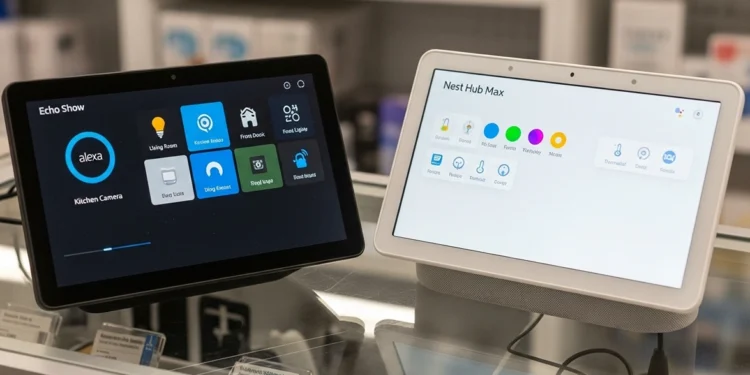
The Google Nest Hub Max sits on the shelf for three hundred dollars and looks like a simple tablet on a speaker. It’s not. It’s a massive sensor array that requires a constant connection to Google’s cloud just to tell you the weather.
The built-in camera uses face matching to “personalize” the experience. This sounds helpful until you realize it’s a permanent eyeball in your living space. If your internet dies, this expensive slab of glass loses most of its brain.
Local control is a secondary thought for this hardware. Most commands travel to a data center before your lights actually turn on. This lag is annoying, but the dependency on a third-party server is the real danger for your home autonomy.
The AI Hype Machine Echo Show 11
Amazon’s latest Echo Show 11 attempts to distract you with a 360-degree swivel and a massive screen. The mechanical base is a physical point of failure waiting to happen. Moving parts in a stationary hub are a gimmick that adds cost without adding value.
The marketing focuses on “Alexa+” and advanced intelligence. These are just fancy ways of saying the device needs to listen to more of your life to work. It’s an aggressive push to gather more data for the retail engine.
The built-in Zigbee and Thread radios are a nice touch for direct hardware pairing. However, the software layer still forces you through the Alexa app for everything. You don’t own the system; you’re just renting space in their garden.
Why These Hubs Fail the Wallet Rule
A product is only a good value if it respects your money over the long term. These hubs fail because they are designed with planned obsolescence in mind. When the manufacturer decides to stop supporting the software, your hub becomes a paperweight.
There’s a hidden cost to these “all-in-one” solutions. You end up buying more expensive brand-name sensors because the hub makes it difficult to use generic alternatives. This creates a cycle of spending that benefits the corporation, not your budget.
Privacy is another cost that doesn’t show up on the receipt. Every time you use the screen to adjust the thermostat, you’re giving away information about your habits. This data is worth more to these companies than the price of the hub itself.
Pros and Cons of a Centralized Headache
| Feature | Assessment |
| Pros | Slick interfaces make it easy for non-tech users to manage basic lights |
| Pros | Large screens provide a decent way to see a doorbell camera feed |
| Pros | Built-in speakers are loud enough for a kitchen background track |
| Cons | Cloud dependency means your home breaks when the internet goes down |
| Cons | Mandatory data harvesting is a fundamental part of the business model |
| Cons | Hardware gimmicks like rotating screens introduce mechanical failure risks |
| Cons | Proprietary ecosystems limit your choice of cheaper third-party hardware |
The Actual State of Smart Home Automation
True automation should happen in the background without a corporate middleman. These hubs do the opposite by putting a big screen in your way. They want to be the center of your attention because that’s how they stay relevant.
Most people would be better off with a dedicated local server that doesn’t have a camera. You can get better performance from a cheap raspberry pi and open-source software. It doesn’t look as pretty, but it actually works when the cloud fails.
The allure of a “total control” dashboard is strong for a reason. It feels like the future we were promised in movies. But that future shouldn’t require a monthly subscription or a direct line to a marketing department.
The Hard Truth
The Google Nest Hub Max and the Echo Show 11 are impressive pieces of engineering that serve the wrong master. They are built to profit the manufacturer first and the user second. You’re paying for the privilege of being monitored.
If you want a pretty digital photo frame that occasionally turns on a light, these are fine. Just don’t expect them to provide true home autonomy. They are gateways to a walled garden, and the walls are getting higher every year.
Avoid the hype and look for hardware that works offline. Your home should function as a private sanctuary, not a data-mining outpost for a tech giant. The convenience isn’t worth the loss of control.
While mainstream users settle for the Amazon Echo or Google Nest Hub 10 ecosystems, the savvy move involves switching to a surprisingly capable local contender (learn more) that ends the cloud dependency trap forever.