Nothing ruins a movie night faster than a buffer pause right at the climax, and trying to work from home while the connection drops is a recipe for a rage quit. My old setup was a patchwork mess of a main router and two cheap extenders that barely talked to each other. It was a constant battle of resetting modems and moving antennas around.
Then I plugged in the NETGEAR Orbi 770.
I honestly didn’t expect a single box to fix everything, but the relief was instant. This isn’t just a spec bump; it’s a complete overhaul of how the signal moves through the house. If you are looking for a NETGEAR Orbi 770 review that skips the jargon and tells you if it actually works, this is it.
Why My Old Setup Was Driving Me Crazy
My house isn’t a mansion, but it has thick walls and a weird layout.
The signal from the ISP-provided router would die halfway to the kitchen. I tried fixing it with range extenders, but they just cut the speed in half and created different network names that my phone refused to switch between. Walking from the office to the living room meant manually toggling WiFi settings just to stay online.
It was a headache.
[CTA Placeholder: Link to Internal Article about “Common WiFi Dead Zone Causes”]
The Orbi system handles this differently. It uses a “mesh” design, which basically means the satellites aren’t just repeating a weak signal; they are talking to the main router on a dedicated channel.
Plugging In The Orbi 770
Setup usually scares me and I hate navigating through browser IP addresses like 192.168.1.1 just to change a password. The Orbi setup happened entirely through an app on my phone. I plugged the main router into my modem, scanned a QR code, and it did the rest.
The satellites were even easier and took me maybe 15 minutes to setup the router. I just placed them where the signal usually drops—one in the hallway and one near the back door—and plugged them in. The app found them automatically.
The Speed Test That Made Me Laugh
This is where the “Relief” kicked in.
I pay for a gigabit connection, but on my old setup, I was lucky to get 300 Mbps over WiFi. With the Orbi 770, I stood in the furthest corner of my house and ran a test.
I hit 900 Mbps.
That is practically hardwired speed, but without the wire. The WiFi 7 tech inside this thing is doing some heavy lifting. It supports speeds up to 11Gbps, which is overkill for what I have now, but it means I won’t have to upgrade this system for a very long time.
[CTA Placeholder: Link to External Article about “Understanding WiFi 7 vs WiFi 6”]
The secret sauce here is the “backhaul.”
Most mesh systems use the same bandwidth for your data and for the satellites to talk to each other. That creates a traffic jam. The Orbi uses a dedicated lane just for that communication. It’s like having a private highway for your data while everyone else is stuck in traffic.
Covering The Dead Zones
The box claims coverage up to 8,000 square feet.
I can’t test that limit, but I can tell you that my backyard is no longer a dead zone. I can sit on the patio and stream 4K video without a single stutter. The signal punches through the exterior brick wall like it isn’t even there.
It handles traffic well too.
We have about 30 devices connected—smart bulbs, cameras, laptops, phones. Even when the kids are gaming and I’m on a video call, nothing slows down. The router has a 2.5 Gig internet port, so if I ever upgrade my plan with the ISP, the hardware is ready for it.
Is It Worth The Investment
This system is definitely an investment.
It sits in a different bracket than the budget routers you grab off the shelf at a big box store. But you have to look at what you are actually buying. You aren’t just buying a plastic box with antennas; you are buying the end of network frustration.
Think about how much time you spend resetting your current router.
Think about the annoyance of lag during a game or a dropped call during a meeting. This system deletes those problems. It is built for people who just want the internet to work, everywhere, all the time, without having to babysit the hardware.
[CTA Placeholder: Link to Internal Article about “Is Mesh WiFi Worth It for Small Homes?”]
It feels solid, too.
The towers look more like modern decor than tech clutter. They don’t have ugly antennas sticking out everywhere, so my spouse didn’t mind having them on the shelf in the living room.
The Verdict on The Orbi 770
My home network nightmare is over.
I don’t think about my WiFi anymore, and that is the highest compliment I can give a router. It just works. The speed is consistent, the coverage is massive, and the setup didn’t make me want to pull my hair out.
If you are tired of spotty connections and constant buffering, this is the fix.
Final Thoughts
If you are ready to stop resetting your router every week, the NETGEAR Orbi 770 is the solution that finally worked for me. But if you want a WiFi 7 fix that saves a little cash for other gadgets, the eero Pro 7 is a solid runner-up.
Wireless Home Networking
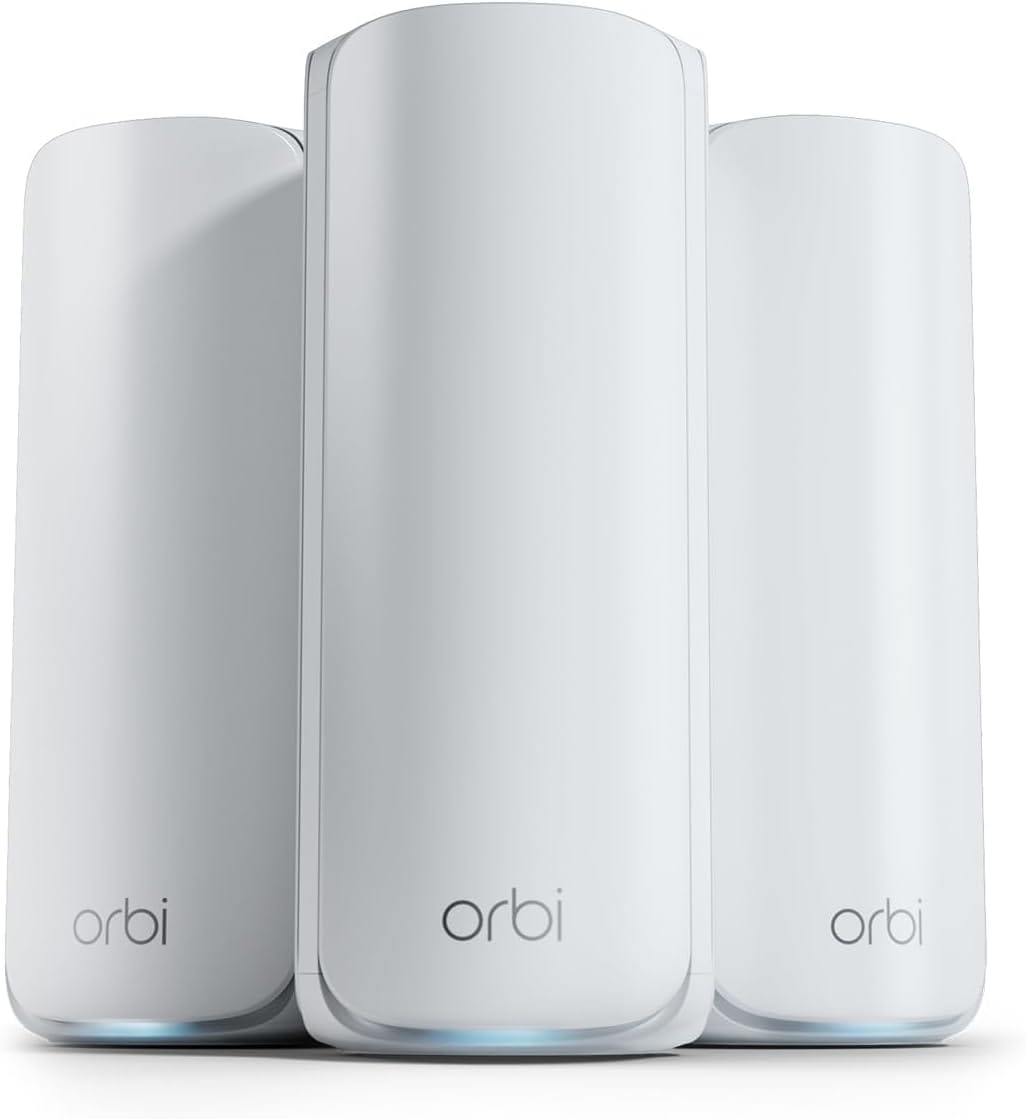
NETGEAR Orbi 770 Series Tri-Band WiFi 7
The Orbi 770 is a WiFi 7 mesh system that blasts 11Gbps speed across 8,000 square feet, handling 100 devices without slowing down. It uses a dedicated backhaul and a 2.5 Gig port to make sure every room gets full signal, finally ending the dead zone headache.